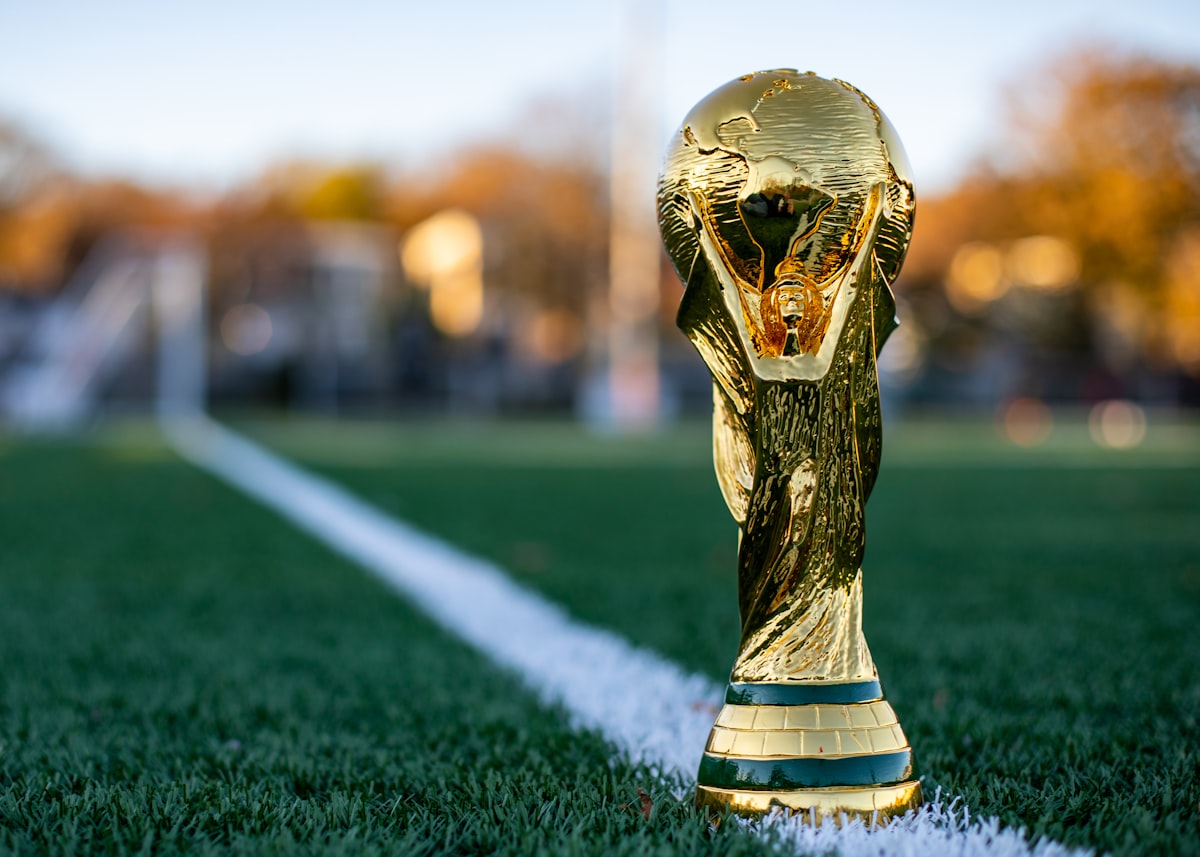
The 2026 World Cup in the United States, Mexico, and Canada will be the first tournament with 48 nations competing. With expanded group stages and a new knockout format, the central question remains eternal: Who will win the World Cup 2026? This is our definitive ranking of the top 10 contenders based on squad depth, current form, tactical setup, and overall team balance.
World Cup 2026 Top 10 Favorites Ranking
1. Argentina — The Defending Champions
Group: J (Argentina, Austria, Jordan, Algeria) Manager: Lionel Scaloni Star Player: Lionel Messi
Argentina arrives as defending world champions and Copa América winners. Scaloni has built a team that blends World Cup experience with an intermediate generation in peak form: Enzo Fernández, Julián Álvarez, and Alexis Mac Allister are undisputed starters at elite European clubs.
Strengths: Defensive solidity with Cuti Romero and Lisandro Martínez anchoring the backline. A midfield capable of both high-press intensity and clean passing. Champion’s mentality—this squad knows how to win decisive matches. The group J draw is favorable, allowing Argentina to arrive at the knockout stages fresh.
Weaknesses: Emotional dependency on Messi, who at 39 will have a reduced physical role. If Scaloni fails to manage his participation carefully, tactical imbalances could emerge. The right-flank transition with a new generation of wingers remains an uncertainty.
Prediction: Clear favorite numero uno through competitive inertia and squad quality. Group J offers an accessible path to the Round of 16.
2. France — The Eternal Contender
Group: I (France, Iraq, Norway, Senegal) Manager: Didier Deschamps Star Player: Kylian Mbappé
France possesses the deepest squad in the tournament. Mbappé, Tchouaméni, Camavinga, Saliba, Konaté—each line features two options of Champions League caliber. Deschamps has proven he knows how to win at the World Cup: final in 2022, champions in 2018.
Strengths: Unmatched squad depth. Deschamps can rotate eleven players and maintain competitive level. Devastating offensive transitions with Mbappé’s pace and wide attacking options. The versatility to adjust tactics mid-tournament without losing quality.
Weaknesses: Deschamps’ pragmatic system can lead to congested matches against organized defensive setups. Mbappé’s relationship with the team has shown moments of tension in recent cycles. Creative depth in the final third beyond individual talent remains uncertain.
Prediction: Second favorite by squad depth and recent tournament experience. Group I presents no serious threats until the knockout round, where France’s track record is flawless.
3. Spain — The European Champions
Group: H (Spain, Saudi Arabia, Uruguay, Cape Verde) Manager: Luis de la Fuente Star Player: Pedri / Lamine Yamal
Spain won Euro 2024 with dominant football and a young generation that now has two additional years of maturity. Pedri, Gavi, Lamine Yamal, and Nico Williams form an attacking nucleus capable of overwhelming any defense globally.
Strengths: Possession control. Spain is currently international football’s most effective possession-retention team. Coordinated high-pressing and the ability to generate numerical superiority on the flanks makes them lethal in group stages and open matches.
Weaknesses: Group H includes Uruguay, a serious rival that could challenge for first place. In knockout matches, the absence of a pure, traditional number nine—a reliable area striker—can punish in tight defensive encounters where possession doesn’t translate to goals.
Prediction: Top 3 by football quality. If De la Fuente finds the balance between possession and vertical play, Spain can reach the final.
4. Germany — The Silent Resurrection
Group: E (Germany, Ivory Coast, Curaçao, Ecuador) Manager: Julian Nagelsmann Star Player: Florian Wirtz / Jamal Musiala
Germany emerged from two consecutive group-stage eliminations (2018, 2022) with radical squad overhaul under Nagelsmann. Euro 2024 at home revealed a team with fresh identity: intense pressing, rapid transitions, and attacking creativity unseen since 2014.
Strengths: Wirtz and Musiala form the tournament’s most destabilizing creative pairing. The defense has stabilized, and midfield with Kimmich provides solidity and distribution. Nagelsmann is a modern tactician who adjusts brilliantly during matches.
Weaknesses: Limited recent knockout-stage success. Germany’s last World Cup knockout victory was 2014. The mental weight of reversing that trend could tell in crucial moments. Group E is manageable, but knockout draw scenarios vary significantly.
Prediction: Fourth favorite with upward trajectory. If the group draw aligns favorably, Germany’s trajectory suggests a deep run.
5. England — The Generation That Must Win Something
Group: L (England, Croatia, Ghana, Panama) Manager: Thomas Tuchel Star Player: Jude Bellingham
England boasts one of the world’s most expensive and talented squads. Bellingham, Saka, Foden, Rice, Palmer—the roster is endless. Euro 2024 final, 2018 semifinal, 2022 quarterfinals. The talent exists; the question is whether mentality matches.
Strengths: World-class individuals at every position. Bellingham alone is capable of deciding matches single-handedly. Wide and midfield depth allows multiple tactical variations. Attack-minded setup with genuine goal-scoring threats.
Weaknesses: England’s tournament history is one of systematic frustration. Tuchel, newly appointed, requires time to embed ideas. Central defense remains the structural weakness: no defensive leader at the level of attacking talent.
Prediction: Fifth by pure talent, but high elimination risk if defensive issues persist. Group L with Croatia demands quality from day one.
6. Brazil — In Transition But Talent-Rich
Group: C (Brazil, Morocco, Haiti, Scotland) Manager: Carlo Ancelotti Star Player: Vinícius Júnior / Rodrygo
Brazil traverses a transition period. The 2022 quarterfinal elimination and irregular South American qualifying created uncertainty. Yet raw materials remain exceptional: Vinícius Jr., Rodrygo, Endrick, and a midfield including Bruno Guimarães and Lucas Paquetá.
Strengths: First-level attacking talent. Vinícius is among the world’s top three players. Individual moments can decide knockout matches. A squad that when clicking can overwhelm opponents through sheer quality.
Weaknesses: Lack of clear collective identity under Ancelotti. Inconsistent defense throughout qualifying. Absence of a dominant defensive midfielder creates transition vulnerabilities. Brazil’s over-reliance on individual brilliance rather than system is exposed against organized teams.
Prediction: Sixth by talent, but an uncertain ceiling. If Ancelotti instills structure before June, Brazil exploits. If not, a quarterfinal exit is likely.
7. Portugal — Ronaldo’s Last Bullet
Group: K (Portugal, Uzbekistan, Colombia, DR Congo) Manager: Roberto Martínez Star Player: Rafael Leão / Bruno Fernandes
Portugal combines world-class veterans with an emerging generation. At 41, Cristiano Ronaldo likely plays his final World Cup. Behind him, Rafael Leão, Bernardo Silva, Bruno Fernandes, and a defense featuring Rúben Dias and Nuno Mendes provide balance across all lines.
Strengths: Tactical versatility. Martínez can deploy a four-back or five-back setup, with or without Ronaldo. Midfield depth and wide attacking options make Portugal unpredictable for opponents.
Weaknesses: Managing Cristiano Ronaldo’s presence creates a tactical debate that could divide the squad and staff. Group K includes Colombia, demanding competition from the opening match with no room for experimentation.
Prediction: Seventh by overall quality. If Martínez intelligently solves the Ronaldo equation, Portugal advances far. If not, pre-quarterfinal elimination is possible.
8. Netherlands — System Over Names
Group: F (Netherlands, Japan, Sweden, Tunisia) Manager: Ronald Koeman Star Player: Cody Gakpo / Xavi Simons
The Netherlands lacks individual superstars but compensates with collective organization and a tactical tradition that renews generationally. Gakpo, Simons, and Gravenberch lead a transition mixing youth with veterans like Van Dijk and De Jong.
Strengths: Defensive organization and match control capability. Koeman prioritizes solidity and ball progression from the back. In a 48-team tournament where effort management is critical, Dutch pragmatism offers advantage.
Weaknesses: Goal scarcity. Netherlands lack a reliable, world-class center forward. Gakpo dependency as offensive reference limits options in matches requiring comebacks. Group F with Japan is trickier than it appears on paper.
Prediction: Eighth by consistency and system. Can reach quarterfinals or semifinals, but lacks the differential factor to win the tournament.
9. Colombia — A Dark Horse With Real Arguments
Group: K (Portugal, Uzbekistan, Colombia, DR Congo) Manager: Néstor Lorenzo Star Player: Luis Díaz / James Rodríguez
Colombia was Copa América 2024 finalist and completed South American qualifying solidly. Lorenzo has given continuity to prior projects with distinct identity: organized pressing, rapid exit, and a Luis Díaz in peak form.
Strengths: Exceptionally cohesive team unit. The combination of Richard Ríos, Jhon Arias, and Luis Díaz in offensive transitions is among South America’s most dangerous. James Rodríguez, despite his age, remains the creative brain in the final third.
Weaknesses: Sharing Group K with Portugal forces qualification battles to the final match. Limited recent experience in advanced World Cup stages (last quarterfinal: 2014) could weigh against European opponents.
Prediction: The tournament’s most solid dark horse. With a group exit as first or second, Colombia possesses arguments for quarterfinals or beyond.
10. Uruguay — Bielsa and the Blues’ Ambition
Group: H (Spain, Saudi Arabia, Uruguay, Cape Verde) Manager: Marcelo Bielsa Star Player: Darwin Núñez / Federico Valverde
Uruguay with Bielsa is nobody’s preferred opponent. The Argentine coach has elevated a generation blending South American grit with European technical quality: Valverde, Núñez, Ugarte, Araújo, and De Arrascaeta form a globally competitive eleven.
Strengths: Intensity without the ball and verticality with it. Bielsa has transformed Uruguay into a team pressing with European club aggression. Valverde is the tournament’s most complete midfielder—covering, creating, and timing runs to the box.
Weaknesses: System fatigue in a long tournament. The intensity Bielsa demands exacts a physical toll from quarterfinals onward. Facing Spain means securing second place realistically, affecting the knockout draw.
Prediction: Tenth but with genuine upset potential. If Bielsa manages physical load, Uruguay becomes the team eliminating a favorite in the Round of 16 or quarterfinals.
Three Dark Horses Worth Watching
Beyond Colombia (already in the top 10), these nations can surprise:
Morocco—2022 semifinalist maintaining that core with Hakimi, Amrabat, and En-Nesyri. Regragui knows World Cup competition. European-based player pool is extensive. In Group C with Brazil, it’s a direct first-place battle.
Japan—Eliminated Germany and Spain in group stage in 2022. The current generation with Kubo, Mitoma, and Kamada is more talented than that side. Moriyasu has built a team that no longer surprises: it competes at parity with any European. Group F with the Netherlands will be a first-place battle.
United States—Home advantage with Pochettino commanding and a golden generation: Pulisic, McKennie, Reyna, Musah. Home advantage in a 48-team format is a genuine factor. They can reach quarterfinals for the first time since 2002.
World Cup 2026 Betting Odds & Market Context
Bookmakers list Argentina and France as co-favorites, with implied odds giving each 12–15% tournament-win probability. Spain and Germany complete the top tier at 8–10%. England and Brazil occupy a second echelon (6–8%), while Portugal, Netherlands, and Colombia range 3–5%. The 48-team format disperses probabilities: no favorite exceeds 15% implied probability, reflecting inherent tournament uncertainty with additional knockout rounds.
These figures are indicative and fluctuate with friendly results and pre-tournament injuries. They are not betting recommendations.
Frequently Asked Questions: World Cup 2026 Favorites
Who is the favorite to win the World Cup 2026?
Argentina is the primary favorite as defending champions, with Messi in what’s likely his final World Cup appearance, and a balanced squad under Scaloni. France ranks second by squad depth and recent tournament experience. Spain completes the podium through Euro 2024 success.
Who will win the World Cup 2026 according to odds?
Bookmakers list Argentina and France as co-favorites at similar probabilities, followed by Spain and Germany. In the 48-team format with expanded knockout rounds, probabilities are more distributed than prior editions. No single nation exceeds 15% implied tournament-win probability.
How many teams play in the World Cup 2026?
The 2026 World Cup features 48 nations for the first time, distributed into 12 groups of four. The top two finishers from each group plus the eight best third-place teams advance to a 32-team knockout phase beginning in the Round of 16.
What is the World Cup 2026 dark horse?
Colombia is the tournament’s most robust dark horse: Copa América 2024 finalist with consolidated tactical system under Lorenzo and players in top European leagues. Morocco (2022 semifinalist) and Japan (which eliminated Germany and Spain in group stage in 2022) are other upset-potential nations.
Where is the World Cup 2026 held?
The 2026 World Cup occurs across three nations: the United States (11 venues), Mexico (3 venues), and Canada (2 venues). The final will be played at MetLife Stadium in New Jersey. It’s the first World Cup with three host nations and 16 host cities.
When does the World Cup 2026 start?
The 2026 FIFA World Cup begins June 11, 2026, and concludes July 19, 2026. Opening match venues are split between the three host nations.
Can the United States win the World Cup 2026 at home?
The USMNT possesses a golden generation under Pochettino with Pulisic, McKennie, Reyna, and Musah. Home advantage is genuinely valuable in a 48-team format. The US can realistically reach the quarterfinals for the first time since 2002, though winning the tournament remains unlikely.
Is Messi playing the World Cup 2026?
Messi is expected to play his final World Cup in 2026 with Argentina. At 39, his role will be reduced physically, but his experience and leadership will be critical for Scaloni’s squad.
Follow comprehensive 2026 World Cup coverage in our tournament hub: match calendar, group standings, team previews, and tactical analysis of all participating nations.