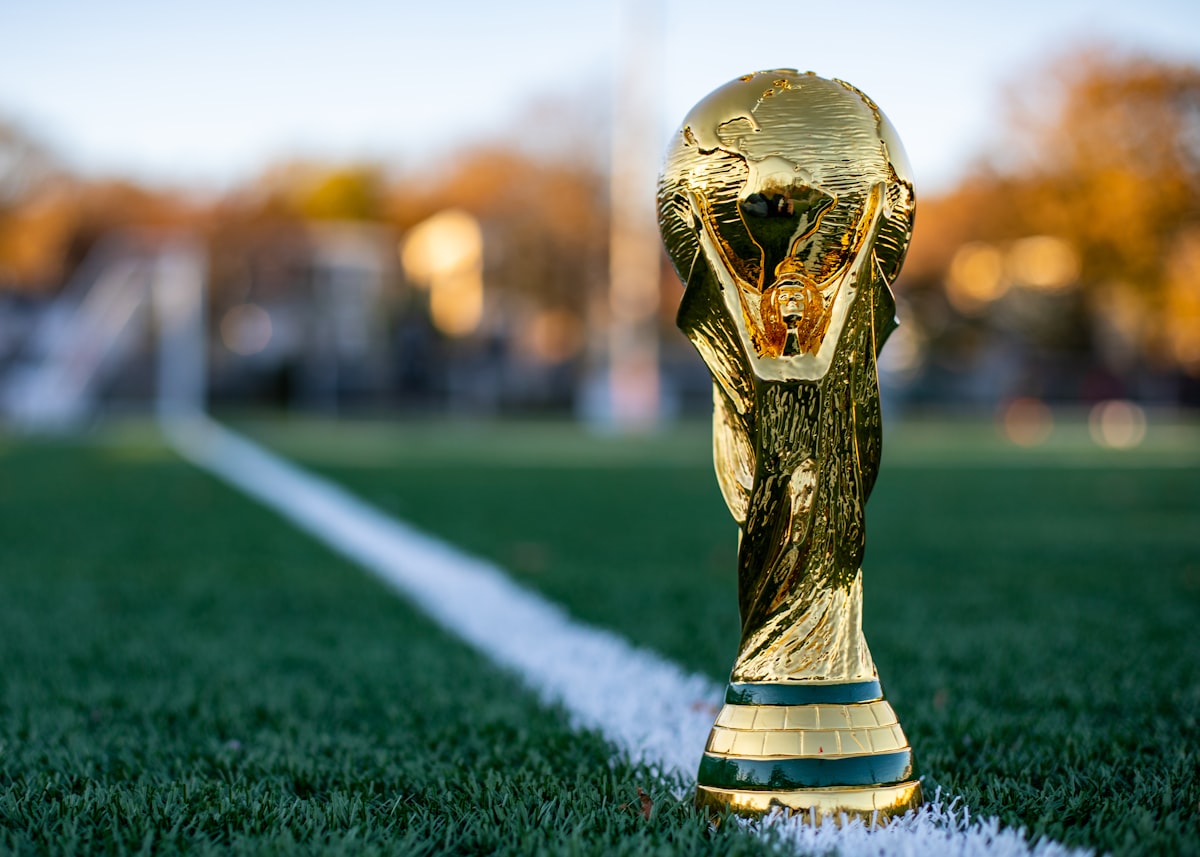
The 2026 World Cup in the United States, Mexico, and Canada will be the first with 48 teams. With an expanded format and a new structure for knockout rounds, the central question remains: who will win the World Cup 2026? This is the definitive ranking of the eight main favorites based on squad depth, recent form, tactical setup, and tournament momentum heading into June 11.
Top 8 Contenders for the World Cup 2026
1. Argentina — The Defending Champions
Group: J (Argentina, Austria, Jordan, Algeria)
Coach: Lionel Scaloni
Star: Lionel Messi
Argentina arrives as the defending world champions and two-time Copa América winners. Scaloni has built a team that blends World Cup experience with an emerging generation at their peak: Enzo Fernández, Julián Álvarez, and Alexis Mac Allister are fixtures in elite European clubs. At 38 years old, Messi will play a reduced role, but his presence as a leader and occasional creator remains invaluable.
Strengths: Defensive solidity with Cuti Romero and Lisandro Martínez anchoring the line. A midfield capable of high pressing and clean buildup. Most importantly, a championship mentality—this group knows how to win knockout matches.
Weaknesses: Emotional dependency on Messi despite his reduced physicality. If Scaloni mismanages his participation, tactical imbalances can emerge. Right-wing transitions and depth beyond the first XI also present questions.
Prediction: Favorite number one by competitive momentum and squad quality. Group J is approachable, allowing Argentina to arrive at the knockout rounds fresh.
2. France — The Eternal Candidate
Group: I (France, Iraq, Norway, Senegal)
Coach: Didier Deschamps
Star: Kylian Mbappé
France possesses the tournament’s deepest squad. Mbappé, Tchouaméni, Camavinga, Saliba, Konaté—every line has two players capable of Champions League impact. Deschamps’ pedigree is undeniable: final in 2022, champions in 2018.
Strengths: Squad depth without peer. France can rotate eleven players and maintain competitive level. Devastating offensive transitions with Mbappé’s pace and Dembélé’s intensity. Every position has quality backups.
Weaknesses: Deschamps’ pragmatism can produce stalemate matches against organized opponents. Tensions between Mbappé and the collective have surfaced in recent cycles. Creativity beyond individual brilliance remains an open question in tight matches.
Prediction: Second favorite by squad and experience. Group I presents no real threats until the knockout rounds, where France’s recent record is near-flawless.
3. Spain — European Champions with Momentum
Group: H (Spain, Saudi Arabia, Uruguay, Cape Verde)
Coach: Luis de la Fuente
Stars: Pedri / Lamine Yamal
Spain won Euro 2024 with commanding football and a young generation now two years more mature. Pedri, Gavi, Lamine Yamal, and Nico Williams form an attacking nucleus capable of dismantling any defense. Spain’s possession-based football looks increasingly effective on the modern stage.
Strengths: Possession dominance. Spain controls the tempo of matches better than any team in international football. Coordinated high pressing and the ability to create overloads on the wings make them lethal in group play and open matches.
Weaknesses: Group H includes Uruguay, a serious rival that can complicate the top-two finish. Knockout rounds expose Spain’s shortage of a pure nine—a true box striker. When possession doesn’t convert to goals, Spain can struggle in tight matches.
Prediction: Top 3 by quality of play. If De la Fuente finds balance between possession and directness, Spain reaches the final.
4. Germany — The Silent Resurrection
Group: E (Germany, Ivory Coast, Curaçao, Ecuador)
Coach: Julian Nagelsmann
Stars: Florian Wirtz / Jamal Musiala
Germany emerged from two consecutive group-stage eliminations (2018, 2022) with radical renewal under Nagelsmann. Euro 2024 at home revealed a team with fresh identity: intense pressing, rapid transitions, and offensive creativity unseen since 2014.
Strengths: Wirtz and Musiala are the most destabilizing creative duo at the tournament. The defensive line has stabilized, and Kimmich provides midfield solidity and distribution. Nagelsmann is a modern tactician who makes in-match adjustments.
Weaknesses: Limited recent World Cup success. Germany hasn’t won a knockout match at the World Cup since 2014. The psychological weight of reversing that trend could surface in decisive moments. Group E is manageable, but knockout opponents won’t be.
Prediction: Fourth favorite with upward trajectory. The group sets up well for a knockout run.
5. England — A Generation Under Pressure
Group: L (England, Croatia, Ghana, Panama)
Coach: Thomas Tuchel
Star: Jude Bellingham
England has one of the most expensive and talented rosters globally. Bellingham, Saka, Foden, Rice, Palmer—the list of world-class names is endless. Euro 2024 final, 2018 World Cup semifinal, 2022 quarterfinals. The talent is undeniable; the question is whether mentality matches ability.
Strengths: World-class individuals in every position. Bellingham can decide matches alone. Depth on the wings and in midfield enables multiple tactical variations. Ball-playing defenders provide flexibility.
Weaknesses: England’s tournament history is one of systematic frustration. Tuchel, newly appointed, needs time to embed ideas. Central defense remains structurally weak—no clear leader at the level of attacking talents. Group L with Croatia demands immediate competence.
Prediction: Fifth by pure talent, but risks early elimination without defensive solidity. Recent tournament history gives reasons for caution.
6. Brazil — Reconstruction with World-Class Talent
Group: C (Brazil, Morocco, Haiti, Scotland)
Coach: Carlo Ancelotti
Stars: Vinícius Júnior / Rodrygo
Brazil is in transition following a 2022 quarterfinal exit and an uneven South American qualifying campaign. Yet the raw material remains exceptional: Vinícius Jr., Rodrygo, Endrick, and a midfield including Bruno Guimarães and Lucas Paquetá offer immense attacking potential.
Strengths: First-tier individual offensive talent. Vinícius is one of three best players globally. The ability to resolve matches through individual moments is an asset in knockout football.
Weaknesses: Lack of collective tactical identity under Ancelotti. Defense has been inconsistent in qualifying; no dominant defensive midfielder creates transition vulnerabilities. Brazil depends too much on flashes of brilliance and too little on system.
Prediction: Sixth by talent, but ceiling uncertain. If Ancelotti installs structure by June, Brazil explodes. If not, a quarterfinal or round-of-16 exit is likely.
7. Portugal — One Last Push with Ronaldo
Group: K (Portugal, Uzbekistan, Colombia, Democratic Republic of Congo)
Coach: Roberto Martínez
Stars: Rafael Leão / Bruno Fernandes
Portugal blends world-class veterans with an emerging generation. At 41, Cristiano Ronaldo will likely play his final World Cup. Behind him, Rafael Leão, Bernardo Silva, Bruno Fernandes, Rúben Dias, and Nuno Mendes offer equilibrium across all lines.
Strengths: Tactical versatility. Martínez can deploy a four or five-back setup, with or without Ronaldo. Midfield depth and wing options make Portugal unpredictable for opponents. No shortage of technical ability in possession.
Weaknesses: Managing Cristiano Ronaldo. His presence generates tactical debate that can divide the squad and staff. Group K with Colombia means competing from day one—no room for experiments. His decline is gradual but real.
Prediction: Seventh by overall quality. If Martínez navigates the Ronaldo equation intelligently, Portugal advances far. If not, elimination before the quarterfinals is plausible.
8. Netherlands — System Over Names
Group: F (Netherlands, Japan, Sweden, Tunisia)
Coach: Ronald Koeman
Stars: Cody Gakpo / Xavi Simons
Netherlands lacks the singular star of other contenders but compensates with collective organization and a tactical lineage renewed every generation. Gakpo, Simons, and Gravenberch lead a transition mixing youth with veterans like Van Dijk and De Jong.
Strengths: Defensive organization and match control. Koeman prioritizes solidity and back-to-front buildup. In a 48-team tournament where energy management is crucial, Dutch pragmatism is an advantage.
Weaknesses: Goal shortage. The Netherlands lacks a world-class target striker. Gakpo as the primary offensive reference limits options when chasing matches. Group F with Japan is more dangerous than it appears on paper.
Prediction: Eighth by consistency and system. Likely quarterfinal or semifinal exit; lacks the differential factor to win the tournament.
Three Dark Horses Worth Monitoring
Beyond the top eight, these teams possess the ingredients for surprise runs:
Uruguay — Marcelo Bielsa has elevated a generation blending South American grit with European technical quality. Darwin Núñez, Federico Valverde, and Sergio Araújo form a competitive spine at world level. Bielsa’s intensity makes them a threat to any opponent. Sharing Group H with Spain means a second-place finish is realistic, setting up winnable bracket matchups.
Colombia — Copa América 2024 finalists with a consolidated tactical system under Néstor Lorenzo. Luis Díaz in form is one of South America’s most dangerous attackers. Limited recent World Cup success (last quarterfinal: 2014) is a question mark, but the collective is well-organized.
USA — Home advantage with Pochettino in charge and a golden generation: Pulisic, McKennie, Reyna, Musah. Playing in front of home crowds across the US, Canada, and Mexico is a tangible advantage. Quarterfinal appearance is realistic; semis would be a breakthrough.
Odds and Market Context
Betting markets list Argentina and France as co-favorites, with implied odds around 12–15% probability each of lifting the trophy. Spain and Germany complete the tier-one group at 8–10%, while England and Brazil sit in a second tier (6–8%). Portugal, Netherlands, and Colombia range from 3–5%.
The 48-team format disperses probabilities: no favorite exceeds 15%, reflecting genuine uncertainty. More knockout rounds mean more upsets. These figures shift with friendly results and injury news. They are not betting recommendations.
Frequently Asked Questions
Who is the favorite to win the World Cup 2026?
Argentina holds the favorite’s role as defending champions with Messi in his final World Cup and Scaloni’s balanced squad. France is second by squad depth and knockout experience. Spain completes the tier-one group as Euro 2024 champions.
Who will win the World Cup 2026 according to the odds?
Market odds list Argentina and France as co-favorites with similar probabilities around 12–15% each. Spain and Germany follow at 8–10%. In a 48-team format with expanded knockout rounds, no team commands overwhelming probability. Odds fluctuate weekly.
How many teams compete in the 2026 World Cup?
The 2026 World Cup features 48 nations for the first time, divided into 12 groups of four. The top two from each group plus the eight best third-place teams advance to the round of 32 knockout stage.
What is the World Cup 2026 dark horse pick?
Uruguay under Bielsa is the most prepared dark horse—a team with system, intensity, and individual quality. Colombia as Copa América finalists with consolidated tactics is also dangerous. USA’s home advantage makes them capable of reaching the quarterfinals.
When does the World Cup 2026 start?
The 2026 World Cup kicks off June 11 and concludes with the final on July 19 in New Jersey. Three host nations—the United States (11 stadiums), Mexico (3), and Canada (2)—stage matches across 16 cities for the first time.
Follow all World Cup 2026 coverage on the main hub: match calendar, group standings, and team previews.